
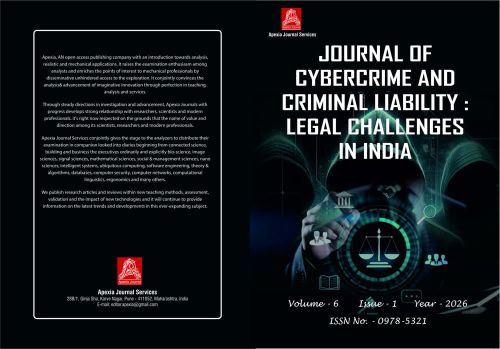
Journal of Cybercrime and Criminal Liability : Legal Challenges in India
Journal of Cybercrime and Criminal Liability: Legal Challenges in India (ISSN: 0978-5321) is a peer-reviewed academic journal dedicated to exploring the rapidly evolving landscape of cyber law, digital crimes, criminal liability, and technology-driven legal challenges. The journal provides a platform for legal scholars, cybersecurity professionals, policymakers, law enforcement agencies, researchers, advocates, and students to examine the complex relationship between technology, crime, and legal regulation in the digital age.
As digital technologies continue to transform communication, commerce, governance, and social interactions, cybercrime has emerged as one of the most significant challenges facing modern legal systems. The journal focuses on critical issues such as cyber fraud, identity theft, data breaches, hacking, ransomware attacks, cyber terrorism, online financial crimes, digital evidence, privacy violations, and emerging forms of technology-enabled criminal activity.
The publication emphasizes the legal and regulatory frameworks governing cybercrime in India, including the Information Technology Act, cyber security regulations, data protection laws, criminal liability principles, and judicial interpretations related to digital offenses. It examines how legal institutions adapt to technological advancements while balancing security, privacy, human rights, and innovation.
The journal also encourages interdisciplinary research connecting law, criminology, information technology, cybersecurity, forensic science, public policy, and governance. Topics include digital investigations, cyber forensic techniques, artificial intelligence and criminal liability, blockchain regulations, online consumer protection, cyber ethics, digital rights, and international cyber law developments.
Through rigorous peer review and scholarly excellence, the Journal of Cybercrime and Criminal Liability: Legal Challenges in India contributes to the advancement of legal knowledge and policy development in the field of cyber law. It serves as an essential resource for professionals and academics seeking a deeper understanding of digital crime prevention, cyber governance, and the future of criminal justice in an increasingly connected world.